
Best AI SRE tools in 2026: 10 AI agents for incident investigation
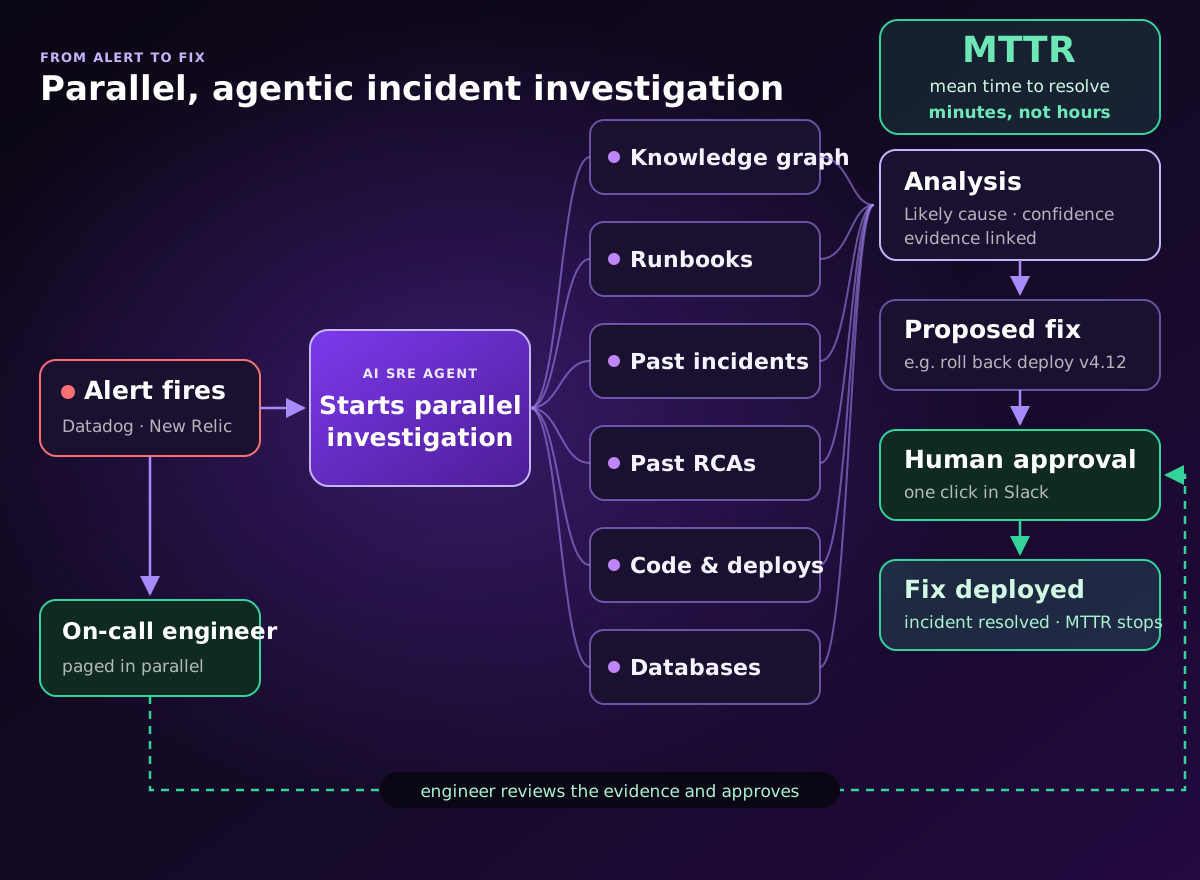
The best AI SRE tools in 2026 are Oppex, Resolve AI, Traversal, Datadog Bits AI SRE, PagerDuty's SRE Agent, Rootly AI SRE, incident.io, Cleric, NeuBird and Causely. They all investigate production incidents with AI agents, but they differ in where they live (a standalone agent, an incident platform or an observability platform), how much of your stack they can read, whether they act on the fix, and how they are priced.
Disclosure: we make Oppex. We have tried to describe every tool fairly, from its public product pages, as of October 2026.
New to the category? Start with what an AI SRE is and how it works.
How we compared them
- Coverage: can it read alerts and telemetry from all your tools, or mainly its own platform's?
- Evidence: does every finding link to the signal behind it, with a confidence level?
- Action: does it stop at a suggestion, or can it run the fix with approval?
- Incident workflow: does it come with on-call and incident management, or sit beside your existing tools?
- Pricing model: included in a plan, metered by usage, or an enterprise contract?
- Data residency: can it run in your own cloud, so logs, traces and code never leave your environment?
At a glance
| Tool | Type | Works across monitoring tools | Acts on the fix | Pricing model |
|---|---|---|---|---|
| Oppex Nova | AI SRE, beside your paging tool or with Oppex on-call | Yes | Yes, on approval or by policy | Included in Business ($20/user/month) |
| Resolve AI | Standalone AI SRE | Yes | Yes (remediation, pull requests) | Enterprise contract |
| Traversal | Standalone AI SRE | Yes | Yes | Enterprise contract |
| Datadog Bits AI SRE | Built into Datadog | Mainly Datadog telemetry | Suggests code fixes | AI credits (about 4 per investigation) |
| PagerDuty SRE Agent | Built into PagerDuty | Yes, through integrations | Recommends and runs diagnostics and remediations | AI platform, metered by AI actions |
| Rootly AI SRE | Add-on to Rootly | Yes, through connectors | Remediation steps, draft pull requests | Separate product, price on request |
| incident.io | Built into incident.io | Yes, through integrations | Suggests | Pro plan; Investigations a paid add-on |
| Cleric | Standalone AI SRE | Yes | Findings in Slack | Contact sales |
| NeuBird Hawkeye | Standalone AI SRE | Yes | Remediation steps | Free trial, then paid |
| Causely | Causal root-cause engine | Yes | Points to the cause | Contact sales |
1. Oppex Nova (Oppex AI)
Oppex AI puts an AI SRE agent, on-call and incident management in one product. Nova investigates every incident across Datadog, New Relic, CloudWatch, Grafana, Splunk and other sources; returns the likely cause, a confidence level and a recommended fix in about two minutes; and runs the fix once an engineer approves it in Slack, or through automated runbooks where policy allows. It also groups alerts before anyone is paged, escalates by phone call, SMS and WhatsApp, and has an MCP server for Claude Code, Codex and Cursor.
- Best for: teams that want the AI SRE and the paging and incident workflow in one plan, across several monitoring tools — or that want to start with Nova investigating beside their current paging tool, such as PagerDuty or Opsgenie, and move paging over later.
- Data residency: on Enterprise, Oppex runs in your own cloud, so incident data stays in your environment, with self-hosted LLMs if required.
- Pricing: Business, which includes Nova, is $20 per user per month; Growth is $12; Starter is free for 3 users; Enterprise, including bring-your-own-cloud, is custom.
2. Resolve AI
Resolve AI is a standalone, multi-agent AI SRE founded by former Splunk leaders. It investigates alerts across code, infrastructure and observability tools, runs several hypotheses in parallel, and can generate pull requests and remediations. It is conversational, so engineers can ask it questions during an incident.
- Best for: large engineering organisations that want a dedicated AI SRE beside an existing paging and incident stack.
- Pricing: enterprise contracts.
3. Traversal
Traversal is a standalone AI SRE for the enterprise, built around a continuously updated model of the production environment and a causal search that tests hypotheses about what broke. American Express is a named customer.
- Best for: large enterprises with complex production estates.
- Pricing: enterprise contracts.
4. Datadog Bits AI SRE
Bits AI SRE, now called Bits Investigation, is Datadog's AI agent. It starts an investigation when a Datadog alert fires, explores root causes in parallel, suggests code fixes and integrates with Slack, Jira and GitHub. It draws on Datadog's own telemetry.
- Best for: teams whose monitoring is all in Datadog.
- Pricing: AI credits, from $500 for 500 credits a month, at about 4 credits per investigation. See Oppex vs. Datadog On-Call and Bits AI SRE.
5. PagerDuty SRE Agent
PagerDuty's SRE Agent is part of its AI agent suite on the PagerDuty Reliability Platform. It learns from related incidents, surfaces context, and recommends and runs diagnostics and remediations; PagerDuty describes it as a virtual first responder, with more autonomous modes rolling out in 2026.
- Best for: organisations already standardised on PagerDuty.
- Pricing: PagerDuty's AI platform is sold in seat bundles with AI-action limits. See Oppex vs. PagerDuty.
6. Rootly AI SRE
Rootly sells AI SRE as a separate product on top of its Incident Response product. It proposes a probable root cause with evidence, remediation steps and draft pull requests, and connects to Claude, Codex and other tools.
- Best for: Rootly customers who want investigation inside their existing incident workflow.
- Pricing: price on request; requires Rootly Incident Response ($20 per user per month). See Oppex vs. Rootly.
7. incident.io
incident.io adds an AI agent to its Slack-first incident response on the Pro and Enterprise plans, with Investigations (root-cause analysis and an autonomous agent) as a paid add-on.
- Best for: teams that run incidents in chat and want AI help inside that flow.
- Pricing: Pro is $25 per user per month, plus on-call and Investigations. See Oppex vs. incident.io.
8. Cleric
Cleric is a standalone AI SRE that investigates incidents and posts its findings in Slack with links to the evidence. It was named a Gartner Cool Vendor in AI for SRE and Observability in 2025.
- Best for: teams that want an investigation agent working inside Slack beside their current tools.
- Pricing: contact sales.
9. NeuBird Hawkeye
NeuBird's Hawkeye is an AI SRE agent that triages and investigates incidents and returns a root-cause analysis with remediation steps. It offers a free self-service trial and an MCP server for Claude Code and Cursor.
- Best for: teams that want to try an AI SRE quickly, especially on AWS.
- Pricing: free trial, then paid plans.
10. Causely
Causely takes a causal-reasoning approach: it models how services depend on each other and reasons from symptoms to the most likely cause, rather than correlating signals after the fact.
- Best for: teams with large microservice estates where failures cascade across services.
- Pricing: contact sales.
Which AI SRE tools run in your own cloud?
An AI SRE reads your logs, traces, deploys and sometimes code, so for regulated teams where it runs can decide the shortlist. From each vendor's public material, October 2026:
| Tool | Runs in your own cloud | Notes |
|---|---|---|
| Oppex | Yes (Enterprise) | Incident data stays in your environment; self-hosted LLMs available |
| Traversal | Yes (bring-your-own-cloud on AWS) | Stored data stays in your account; uses external frontier models for the agent |
| NeuBird Hawkeye | Yes (in your VPC) | Uses your own Amazon Bedrock models; also offered as SaaS |
| Cleric | Yes (in your VPC) | Read-only access to your existing tools |
| Causely | Yes (bring-your-own-cloud) | Also offered as SaaS |
| Resolve AI | Not published | Ask the vendor |
| Rootly AI SRE | Single-tenant instance hosted by Rootly | Not in your own cloud |
| incident.io | Not published | Hosted service |
| Datadog Bits AI SRE | No | Runs in Datadog's cloud on Datadog data |
| PagerDuty SRE Agent | No | Hosted service |
Whichever you pick, ask two questions: where is incident data stored, and where does model inference run?
How to choose
- Already all-in on one observability platform? Its built-in agent (Datadog Bits) sees that platform's data best.
- Want a dedicated agent beside your current paging tool? Look at the standalone agents (Resolve AI, Traversal, Cleric, NeuBird) — or Oppex, whose Nova agent investigates a copy of every alert while your current tool keeps paging, so you can judge its findings before changing anything.
- Want fewer tools? An AI SRE built into your on-call and incident platform (Oppex, PagerDuty, Rootly, incident.io) investigates where the incident is already being handled.
- Strict data-residency rules? Oppex Enterprise, Traversal, NeuBird, Cleric and Causely can run in your own cloud (see the table above); ask where LLM inference runs, too.
- Whatever you pick, test it in shadow mode first: let it investigate a week of your real alerts without paging anyone, and compare its conclusions with your engineers'.
Frequently asked questions
What are the best AI SRE tools?
The main AI SRE tools in 2026 are Oppex Nova (Oppex AI), Resolve AI, Traversal, Datadog Bits AI SRE, PagerDuty's SRE Agent, Rootly AI SRE, incident.io's AI investigations, Cleric, NeuBird Hawkeye and Causely. They split into standalone AI SRE agents, agents built into an incident management platform, and agents built into an observability platform.
Which tools use AI to find the root cause of production incidents?
AI SRE agents find likely root causes by correlating alerts with deploys, metrics, logs, traces and past incidents. Tools that do this include Oppex, Resolve AI, Traversal, Datadog Bits AI SRE, PagerDuty, Rootly, incident.io, Cleric, NeuBird and Causely. The strongest show the evidence behind each finding and a confidence level.
How much does an AI SRE cost?
Pricing models vary. Standalone AI SRE vendors such as Resolve AI and Traversal sell enterprise contracts. Platform vendors meter AI: Datadog bills Bits AI SRE in AI credits, PagerDuty meters AI actions, and Rootly and incident.io sell AI investigation as a separate product or add-on. Oppex includes its AI SRE agent in the Business plan at $20 per user per month.
Can an AI SRE run in our own cloud?
Several can. Oppex Enterprise runs in your own cloud with self-hosted LLMs if required. Traversal offers bring-your-own-cloud in your AWS account, NeuBird can deploy in your VPC using your own Amazon Bedrock models, Cleric runs in your VPC, and Causely offers bring-your-own-cloud. Agents built into Datadog and PagerDuty run in the vendor's cloud. Also check where LLM inference happens: some in-cloud deployments still send prompts to an external model provider.
Is there an AI agent that investigates production incidents automatically?
Yes. Every tool on this list starts investigating automatically when an alert fires, gathering context and proposing a likely cause. They differ in how many monitoring tools they can read, whether they show evidence for each finding, and whether they can act on the fix.